

Picture a distillery with one still, two people and a federal permit. Not a brand you have heard of. It opened in a converted garage three years ago and sells most of its bottles within forty miles. Every month, this operation owes the federal government an account of what it made, moved, bottled, sold, and lost, in a unit of measure that doesn’t exist anywhere else in business, with every number supported by a record showing when it was written.
I run a distillery like that in New York, and I file those reports. Here is what the month looks like, and why the software most producers buy cannot do it.

Week one: the still runs, and the counting starts
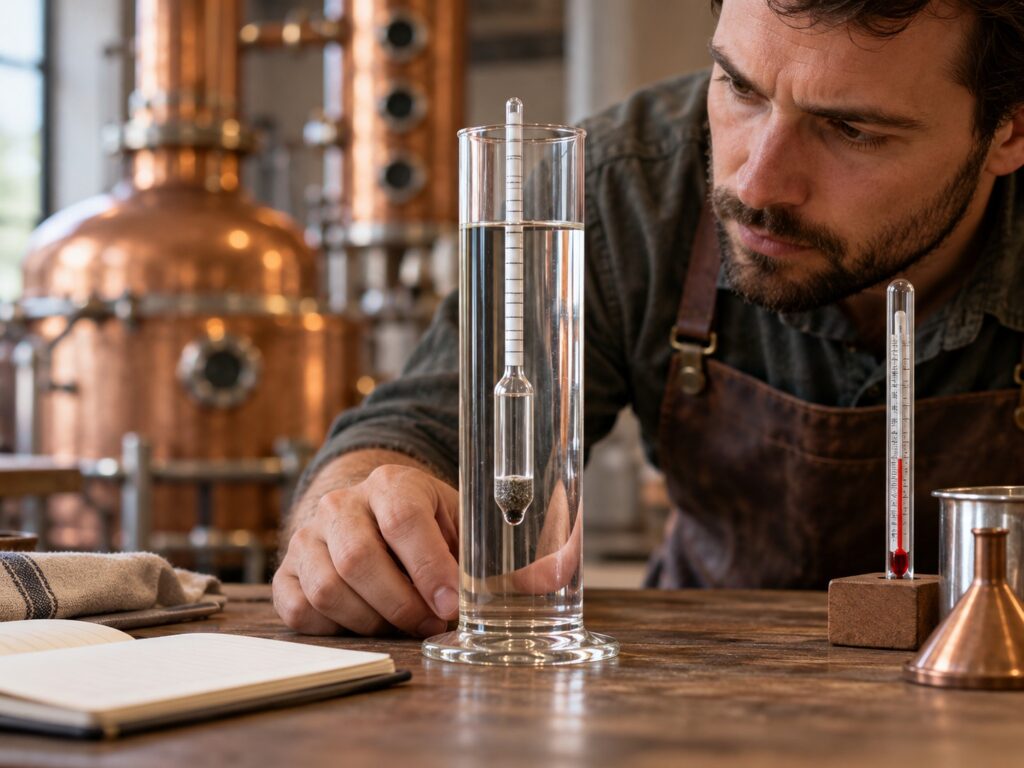
The distiller runs a batch. Out of the still comes spirit at, say, 130 proof. Before anything else happens, they gauge it: they measure the volume, read the proof with a hydrometer, read the temperature beside it, and correct the proof to what it would be at 60 degrees Fahrenheit using tables the government publishes. Then they combine the volume and corrected proof into proof gallons, the only number the Alcohol and Tobacco Tax and Trade Bureau cares about. Fifty gallons at 130 proof is 65 proof gallons. Fifty gallons at 100 proof is 50. The same tank of liquid has a different taxable quantity depending on its strength.
Business software counts units. It does not do this arithmetic, and it has no field for the temperature the hydrometer was read at, which is the first thing an auditor asks about.
Week two: the spirit moves, and the accounts have to agree
The new make goes into barrels. In federal terms, it just moved from the production account to the storage account, and that single movement has to appear on two separate monthly reports: Form 5110.40 for production and Form 5110.11 for storage. If the two reports do not show the same proof gallons leaving one and arriving in the other, the distillery has a reconciliation problem before the month is half over.
Later, older barrels come out of storage to be proofed down and bottled. That is a move into the processing account and a third form, 5110.28. Three accounts, three reports, and every gallon in exactly one of them at any given moment. An inventory module has locations. It has no idea that a location is a tax account, or that moving between two of them creates an obligation on both ends.
Week three: things disappear
Barrels evaporate. A line leaks. A bottling run comes out a few bottles short of the math. The rules require every loss to be recorded, by account and by cause, in proof gallons. That matters because a loss the distillery cannot explain can be taxed as if the spirits had been sold. The difference between “lost to evaporation in storage” and “unaccounted for” is a tax bill.
Week four: the tax event
Bottles leave the bonded premises for a distributor or the tasting room. That is the moment federal excise tax is determined: $13.50 per proof gallon at the full rate, or $2.70 per proof gallon on the first 100,000 proof gallons a distillery removes in a year, which is the rate nearly every small producer pays. Not when the invoice goes out. Not when the check clears. When the spirits cross the line.
A case of twelve 750 millilitre bottles at 80 proof is about 1.9 proof gallons. At the reduced rate, that is a little over five dollars of federal tax per case; at the full rate, more than twenty-five. The system must know which rate applies, so it must keep a running count of proof gallons removed since January and tie the tax to removal, not sale.
The fifteenth of the next month
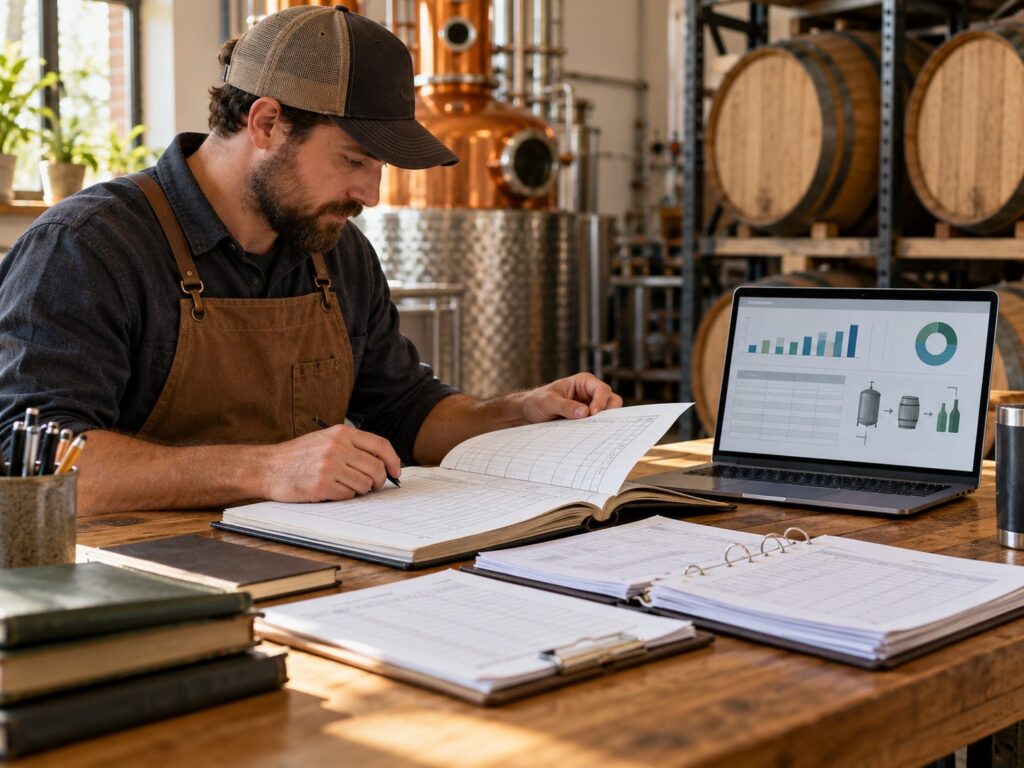
The three operations reports are due. Each summarizes the month’s records, and the government audits those records. Regulations require them to be kept for at least three years, created at the time of the event, and supported by the original gauges. An auditor does not ask whether the form balances. An auditor asks for the record behind line 14, when it was entered, and whether anyone changed it afterward.
This is where generic software fails quietly. A spreadsheet can be edited without a trace. Most inventory and accounting systems let a user overwrite a quantity in place, and even those that log the change don’t know the government already filed the old value. The filed report and the records drift apart one correction at a time, and nobody finds out until the audit.
Why the usual software does not fit
It is tempting to blame the vendors, but the mismatch is structural. Ordinary business software is built around transactions that update a balance, and you look at the balance. Alcohol compliance works the other way around: the individual events are the record, and you have to rebuild every balance for any month and any account in proof gallons from the original readings. You can add a proof field to an inventory system in an afternoon. You cannot add the gauging math, the three-account structure, the loss rules, the tax trigger and the untouchable timestamp without building a different product.
What a small producer should look for
- Proof gallons computed from a gauged volume and a temperature-corrected proof on every entry, never typed in.
- Production, storage and processing as real accounts, with every transfer landing on both sides.
- Record losses by account and cause, and warn before filing if something is unexplained.
- Tax tied to the removal, with the year-to-date count deciding the rate.
- Server-side timestamps the user cannot change, and a flag when a filed month is edited later.
- The system generates three monthly reports from the records and checks them against each other before anything goes out.
- A plain export an auditor can read without a login.
The accounting package can keep doing the accounting. The thing that holds the bond has to be built for the bond. Small producers who understand that before they buy, they spend one afternoon setting up the right tool instead of spending one weekend a month rebuilding the government’s numbers by hand.
Ben Terebelo is the master distiller at Terebelo Distillery in New York and the founder of TTBMath.com, a free compliance and proofing platform for craft distilleries, wineries and breweries. He has appeared on Discovery’s Moonshiners: Master Distiller and has been featured in Forbes.